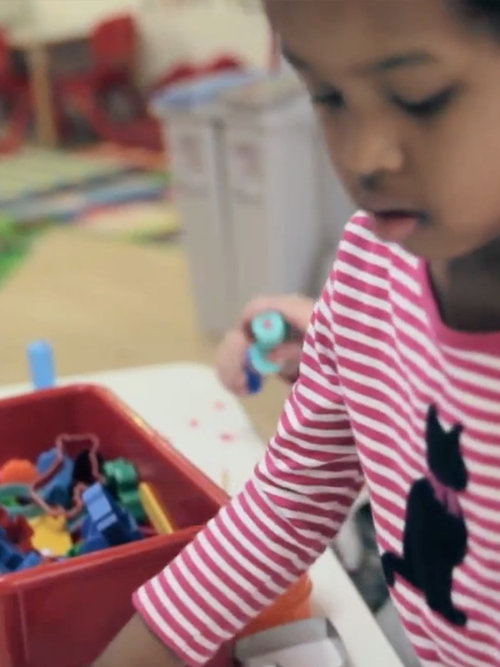
Play is a child’s work. Play is how children learn. The power of play and letting children be themselves, rather than pushing them to do things they are not yet capable of, stands out as an essential part of child development. Children need to be given opportunities to wonder, be creative, and think both in and outside the box. They do not need facts. They need the freedom to be.
Reading, writing, and learning will always come naturally and instinctively to academics. Children play with objects and count them; children play with blocks and balance them on top of one another to build towers, learning mathematical concepts in their unique way. They look for the initial letters of their names and recognize them in the classroom; they also do jigsaw puzzles, which serve as a stepping stone to literacy by helping them put letters together to create words. They do it all naturally.
Children need to be guided in many ways to achieve these ideals; however, developing their self-confidence and trusting themselves in what they do is their life insurance policy. Being confident, independent, and having a good sense of self are the keys.
What may seem like an uncomplicated and straightforward way for children to entertain themselves is, in fact, a complex process that affects all aspects of a child’s life. The famous educational philosopher Lev Vygotsky said, “Play shapes how children make sense of their worlds, how they learn thinking skills, and how they acquire language.”
This article by Valerie Strauss in The Washington Post illustrates a compelling study on academics versus intellectual goals for children, called Lively Minds, by Lilian G. Katz. The report examines the concept of ‘earlier is better’ as an ideal in academic instruction for young children and how imaginative play is a crucial component of a child’s normal development.